LINK Capstone deck
Capstone Presentation
MBA capstone presentation

LINK: from fragmented SMB operations to a finance-aware operating layer.

This deeper capstone deck explains the research chain behind LINK: business-plan requirements, market selection, completed primary research, competitive logic, prototype evidence, operating model, financial assumptions, and validation plan.

Business plan Market research Product mockups Operating model
27
Capstone slides

Structured for a teacher-facing defense of decisions, evidence, trade-offs, and gaps.

7
Interface concepts

Seven mockup screens in one live prototype illustrate the intended experience, not complete functionality.
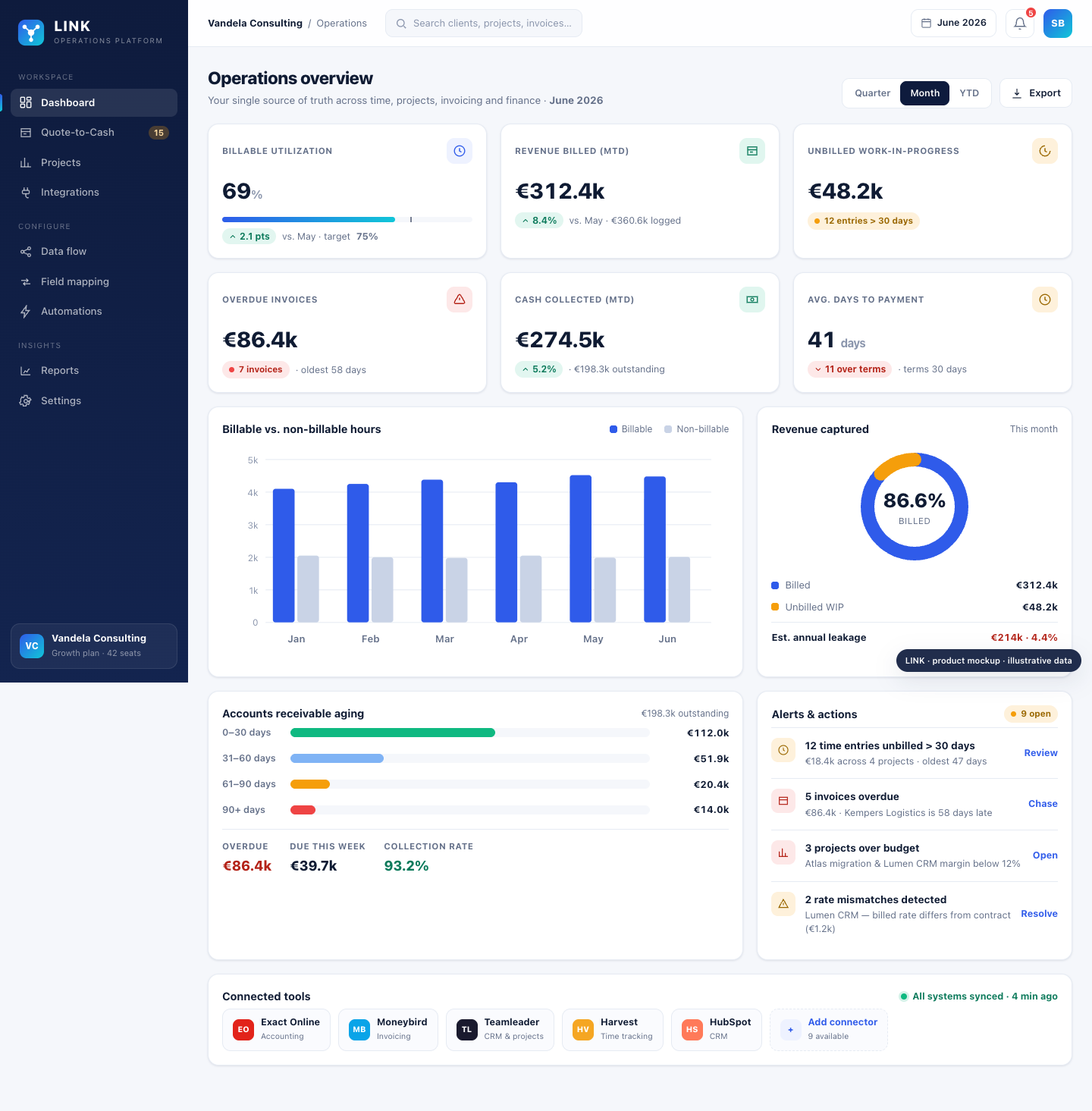
link.app / dashboard
LINK product dashboard

Set the deck up as a capstone defense, not only a pitch.

  • Purpose: Show how the team moved from a broad operating-fragmentation problem to a focused business plan.
  • Scope: Cover research, market selection, product prototype, operating model, financial assumptions and validation.
  • Tone: The teacher should hear evidence, trade-offs and remaining risks.
  • Transition: Move from concept excitement into business-plan discipline.
How this answers the assignment

The presentation follows the business-plan structure expected in the capstone.

The course material asks for the opportunity, people, business environment, market, marketing, operations, financial logic, risks, and appendices. The deck now mirrors that structure instead of only selling the idea.

1

Opportunity

Problem, mission, customer pain, solution concept, and why the issue matters commercially.

2

Environment

Industry background, market screening, PESTEL, Five Forces, and competitor alternatives.

3

Execution

Marketing wedge, operating model, delivery process, technology architecture, suppliers, and staffing.

4

Judgment

Financial assumptions, risks, limitations, and what must be validated before launch.

Tell the assessor how to read the presentation.

  • Course fit: The deck follows the expected business-plan structure: opportunity, environment, execution and judgment.
  • Coverage: Point to market, marketing, operations, people, financial logic, risk and appendices.
  • Message: LINK is being assessed as a complete business plan, not just as a product idea.
  • Use: This slide creates the rubric for the rest of the presentation.
Core question

Can growing SMBs scale without replacing the tools they already depend on?

Our starting hypothesis was that many SMBs are digitally active but operationally fragmented. The challenge is not simply adopting software; it is coordinating workflows and data across the stack.

Problem lens

Fragmentation appears when project delivery, time capture, invoicing, reporting, and finance stop sharing a reliable operating truth.

Customer lens

The target customer is a Dutch professional-services SMB where quote-to-cash is visible, frequent, and financially consequential.

Business lens

The business opportunity is to connect existing tools, add workflow ownership, and productize the repeated implementation learning.

Frame the central analytical question.

  • Question: Can growing SMBs scale without replacing the tools they already depend on?
  • Distinction: Software adoption is not the same as operational coherence.
  • Thesis: Digitally active firms can still lack a reliable shared truth across work, billing and finance.
  • Implication: LINK is about coordination, workflow ownership and data confidence.
Research design

We combined secondary research, three founder interviews, and product prototyping.

Secondary research

Industry data, SME digitalization, PSA category proxies, Dutch market structure, policy direction, competitor sources, review platforms.

+

Completed primary research

Three directional founder interviews tested workflow pain, alternatives, trust, urgency, and buying logic.

+

Product evidence

Seven interface concepts in one interactive prototype translate the business concept into intended screens, workflows, and requirements.

Be transparent about the research chain.

  • Secondary research: Defines the market context, competitors, policy direction and category logic.
  • Primary research: Three founder interviews tested workflow pain, alternatives, trust, urgency and buying logic.
  • Prototype evidence: Makes the idea concrete enough for customer walkthroughs.
  • Guardrail: Do not imply the current research already proves broad market demand.
Problem definition

The issue is not lack of tools. It is lack of a shared operating layer.

57%
Late-payment exposure

Late payments affect nearly this share of European businesses.

Intrum 2026
12%+
Revenue received late

More than this share of European business revenue arrives after the due date.

Intrum 2026
74+ days
Working days chasing invoices

European firms spend more than this much working time each year chasing overdue invoices.

Intrum 2026
4.5%
Revenue leakage benchmark

SPI Research reports leakage at this share of total professional-services revenue.

SPI Research 2025

Teacher-facing takeaway

The problem is business-model relevant because it affects margin, cash flow, management visibility, and the ability to scale without adding administrative headcount.

Sources: Intrum 2026; SPI Research 2025.

Use data to support the problem logic, not to overclaim demand.

  • Problem: Fragmented operations create administrative and financial consequences.
  • Commercial link: Connect the figures to margin, cash flow, visibility and scaling without admin headcount.
  • Evidence role: Payment-report numbers make the cash pain concrete; the leakage benchmark links it to professional services.
  • Guardrail: Demand still needs validation through design partners.
Industry background

Enterprise software is growing, but integration demand is growing with it.

More software adoption does not remove coordination problems. In digitally mature markets it can increase the number of tools, workflows, APIs, dashboards, and handoffs that must stay aligned.

Software growth

European enterprise software remains a large and expanding category across CRM, ERP, finance, and operational systems.

Integration demand

The adjacent system-integration market shows that adopting software does not automatically solve cross-system coordination.

Dutch relevance

The Netherlands is digitally mature, making it a strong market for studying the gap between tool adoption and operating maturity.

Sources: Market Data Forecast 2025, 2026; European Commission 2025a; Statista 2026b, 2026c.

Explain why integration remains a meaningful category.

  • Category logic: Enterprise software growth means firms run more systems, APIs and workflows.
  • Integration demand: More adoption can create more coordination work rather than less.
  • LINK focus: The company targets workflow coordination in multi-tool environments, not enterprise software broadly.
  • Dutch relevance: A digitally mature market is a strong place to study the gap between adoption and operating maturity.
Appendix C logic

The wedge was selected through four screening decisions, not intuition.

We screened for markets where customers already have enough digital tools to create fragmentation, and enough governance or operational pressure to care about traceability and control.

1. Region screenWestern Europe scored strongly because GDPR-level regulation combines with mature cloud and SaaS adoption.
2. Country screenThe Netherlands was chosen as a practical proving ground: digitally mature, English-friendly, compact, and EU-regulation aligned.
3. Vertical screenServices beat manufacturing for first entry because the pain is easier to surface and implementation is lighter, even though manufacturing remains attractive later.
4. Workflow wedgeQuote-to-cash was selected because it links delivery, time, invoicing, cash, margin, and compliance in one recurring process.

Strategic implication

The initial market is not the biggest possible TAM. It is the smallest credible proving ground where customer pain, buying trigger, prototype scope, and measurable ROI can line up.

Fit signalHigh digital maturity plus workflow fragmentation
Urgency signalBilling, contractor, invoice, and reporting pressure
Proof signalMeasurable reduction in admin time, leakage, and invoice delay
Sources: European Commission 2025a; Netherlands Enterprise Agency n.d.; European Commission n.d.c, n.d.d; CBS 2026.

Show that market entry was a sequencing decision.

  • Region: Western Europe combines digital maturity with GDPR-level governance pressure.
  • Country: The Netherlands is practical for pilots: digitally mature, compact and EU-aligned.
  • Vertical: Services beat manufacturing for first entry because pain is easier to surface and implementation is lighter.
  • Workflow: Quote-to-cash links delivery, time, invoicing, cash, margin and compliance.
  • Academic point: Start where the operating-layer thesis is narrow, frequent and measurable.
Market screening

We treated market size as a funnel, not a single inflated TAM.

The plan narrows from a broad Europe-first operating-layer opportunity to a Dutch professional-services beachhead where the workflow problem is concentrated and testable.

13.88M
SMEs across seven screened European countries
534,940
Dutch firms in selected service SBI codes, 0-250 employees (proxy)
2,965
Initial 20-50 employee ICP proxy in the same SBI-code set

Why this is academically stronger

A funnel avoids overstating the opportunity. It shows a broad market context, then a reachable first segment, then an obtainable customer pool for Year 1 validation.

Count-based sizing Narrow wedge Validation-first
Sources: European Commission 2025b-h; CBS 2026.

Present market size as a funnel, not an inflated TAM.

  • Broad context: Start with the screened Europe-first SME pool.
  • Serviceable-market proxy: Narrow to 534,940 Dutch firms in selected project-based-service SBI codes, 0-250 employees.
  • ICP proxy: Use the 2,965 firms in the same SBI-code set with 20-50 employees as the first testable pool.
  • Why stronger: The plan does not need large market share; it needs a defensible foothold with acute pain.
Target customer

Dutch professional-services SMBs are the first testable wedge.

Ideal customer profile

GeographyNetherlands
Firm typeProfessional-services and consulting firms
Size20-50 employees
Operating modelProject-based delivery with quote-to-cash dependence
Pain pointsBilling delays, reconciliation effort, weak visibility, fragmented finance data

Why professional services?

Work, time, invoices, and cash are tightly linked, so fragmentation is easier to observe and quantify.

Why 20-50?

Complexity is meaningful, but full ERP or PSA migration can still feel too heavy for the buyer.

Why quote-to-cash?

It touches revenue, margin, compliance, and management confidence in one recurring workflow.

Why Netherlands?

High digital maturity, strong professional-services base, and EU-relevant data and invoicing direction.

Make the ICP feel intentional.

  • Segment: Dutch professional-services and consulting firms.
  • Size band: 20-50 employees: complex enough to feel pain, not necessarily ready for replacement.
  • Workflow fit: Work, time, invoices and cash are tightly linked and recurring.
  • Business driver: The buyer cares about billing speed, fewer errors, profitability visibility and reduced manual reconciliation.
Primary research role

The primary research is directional, not statistically representative.

Three founder interviews provide directional—not statistically representative—evidence. All recognized operational friction, but urgency depended on whether it affected the firm's core value or risk axis.

Evidence collected

Three founder interviews across firms of approximately 15, 17-20, and 25 employees explored workflows, alternatives, trust, and buying logic.

Central finding

Fragmentation was recognized in all three firms, but commercial urgency varied with its effect on the firm's core value or risk axis.

What it cannot prove yet

It does not yet prove market-wide demand, conversion rate, willingness to pay, or implementation economics.

Handle primary research with rigor.

  • Evidence: Three founder interviews provide directional customer evidence across different firm sizes and operating models.
  • Finding: All three recognized friction, but urgency varied according to whether it affected the firm's core value or risk axis.
  • Use: The findings refine ICP selection, messaging, objections and prototype follow-up.
  • What it cannot prove: Market-wide demand, conversion rate, willingness to pay or implementation economics.
Primary research instrument

The interview framework separated acknowledged friction from purchase-worthy pain.

Interviews mapped current workflows and economic consequences before testing alternatives, trust, buying process, pricing, and demo interest.

ScreenerConfirm ICP fit: Dutch or adjacent project-based SMB, 20-50 employees, operator or buyer perspective.
Workflow mapTrace client/project setup, time capture, approval, invoicing, payment status, and reporting handoffs.
Pain sizingAsk for recent examples, hours lost, delayed invoices, missed billing, reporting effort, and cash-flow effects.
AlternativesCompare spreadsheets, Zapier/Make/n8n, consultants, PSA/ERP, internal builds, and unresolved workarounds.
Buying processIdentify budget owner, trust requirements, proof needed, preferred packaging, and realistic annual budget range.

What would count as validation?

Strong signalWeekly pain, measurable billing/cash impact, budget owner engaged, and pilot willingness.
Weak signalProblem is interesting but infrequent, already solved, or owned by no clear decision-maker.
Disconfirming signalCustomers prefer ERP replacement, tolerate manual work, or see data-access risk as unacceptable.

Show how the interview framework distinguished recognized friction from real buying pain.

  • Sequence: Map the workflow before introducing the solution.
  • Pain sizing: Ask for hours lost, billing delays, missed revenue, reporting effort and cash-flow impact.
  • Alternatives: Compare spreadsheets, automation tools, consultants, PSA or ERP and unresolved workarounds.
  • Validation signal: Strong signal is measurable pain plus budget ownership plus pilot willingness.
  • Disconfirming signal: Weak pain, no owner, existing solution or unacceptable data-access risk.
Analysis frameworks

PESTEL and Porter's Five Forces shaped the strategic interpretation.

PESTEL summary

Political/legalSME digitalization, invoicing, privacy, and contractor-classification pressure support cleaner records.
EconomicEfficiency pressure supports demand, while SMB cost caution raises the ROI bar.
TechnologicalCloud adoption and AI-readiness support the category, but API dependence creates risk.
SocialSmaller firms are expected to operate with larger-firm speed and control.

Five Forces summary

RivalryMedium-high, fragmented across tools, platforms, automation, and services.
SubstitutesHigh: spreadsheets, admin labor, and ad hoc automations are strong default alternatives.
BuyersMedium-high: SMB buyers are cost-conscious and cautious about operational disruption.
SuppliersLow-medium: cloud is accessible, but upstream APIs and vendors matter.

Summarize the frameworks as a balanced strategic read.

  • PESTEL: Policy, digital maturity, privacy, invoicing and contractor pressure support the opportunity.
  • Five Forces: Rivalry, substitutes and buyer caution keep the market demanding.
  • Execution implication: LINK must win through domain specificity, credibility and repeatable delivery.
  • Guardrail: The environment is attractive, but not frictionless.
Competitive analysis

The alternatives are fragmented across categories, not one direct rival.

Workflow ownership
Low disruption
Work-management tools
Automation tools
PSA / ERP platforms

Manual workarounds

Default substitute: no purchase decision, but hidden cost grows.

Asana / monday

Coordinate tasks, but do not own finance-aware quote-to-cash logic.

Zapier / Make / n8n

Connect tools, but leave governance and exception handling to the customer.

Scoro / Odoo

Offer deeper control, but often through heavier migration and standardization.

Explain competition as paths buyers can choose.

  • Default path: Manual admin and spreadsheets remain the hardest substitute because they hide inside salaries.
  • Coordinate path: Asana and monday help projects, but not finance-aware quote-to-cash ownership.
  • Automate path: Zapier, Make and n8n move data but leave governance and exception handling to the customer.
  • Replace path: Scoro and Odoo offer deeper control but often require heavier standardization.
  • LINK path: Connect existing tools with workflow ownership and lower disruption.
Dutch substitute analysis

The most credible substitute may be the local stack the customer already trusts.

For Dutch SMBs, LINK competes not only with global software categories, but with familiar accounting, invoicing, work-management, and advisory relationships that already sit inside the workflow.

Exact / Moneybird

Trusted finance and invoicing anchors. LINK must complement them, not ask customers to abandon them.

Teamleader / AFAS

Local all-in-one or business-platform routes. They validate demand, but can imply more standardization.

Accountants / advisors

Trusted influencers for finance-process change. They can be a channel, reviewer, or competitor.

Manual admin

The hardest competitor is often doing nothing, because spreadsheet work hides inside existing salaries.

Positioning consequence

LINK should describe itself as the operating layer around the existing stack, with finance-aware controls and implementation support.

Go-to-market consequence

Early pilots should include accountant comfort, clear data-flow diagrams, EU hosting posture, and no-rip-and-replace messaging.

Ground the competitive story in Dutch buyer reality.

  • Trusted stack: Exact, Moneybird, Teamleader and AFAS may already be embedded in the workflow.
  • Trusted people: Accountants and local advisors can influence finance-process decisions.
  • Positioning consequence: LINK should complement familiar systems, not sound like a replacement threat.
  • GTM consequence: Pilots should include EU hosting posture, clear data-flow diagrams and accountant comfort.
Strategic conclusion

LINK's white space is connect-rather-than-replace plus finance-aware workflow ownership.

Integration over replacement

Lower adoption friction by working with the customer's existing stack.

Workflow logic

Own the quote-to-cash operating logic, not just data visibility.

SMB economics

Package repeated patterns so integration is not bespoke enterprise consulting.

AI-ready foundation

Structured data and process context make later automation more reliable.

Connect the research to LINK's strategic position.

  • White space: Connect-rather-than-replace plus finance-aware workflow ownership.
  • Differentiation: More specific than generic automation, lighter than all-in-one replacement and more repeatable than bespoke consulting.
  • SMB economics: Package repeated patterns so integration does not remain enterprise-priced consulting.
  • Future value: Structured data and process context make later automation more reliable.
Solution design

The Digital Baseplate sits between existing tools and operating decisions.

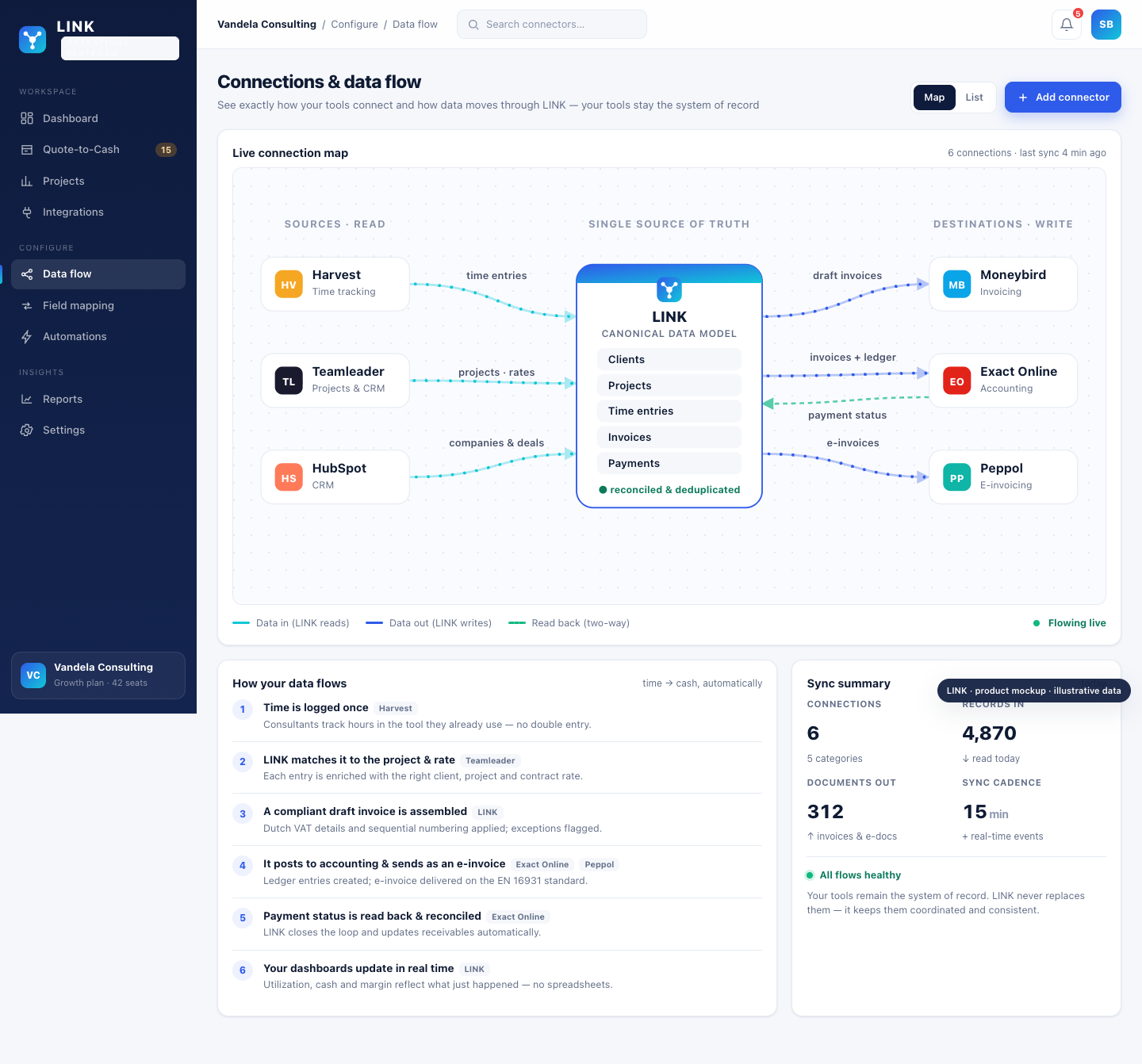
What LINK does

ReadsTime, project, CRM, invoice, payment, contractor, and accounting data from existing tools.
ResolvesMaps records into a canonical operating model and source-of-truth rules.
ControlsApplies workflow logic, reconciliation, alerts, and exception handling.
ReturnsDashboards, invoice outputs, clean records, notifications, and later automations.
link.app / connections
LINK connection map

Explain the product through four verbs.

  • Reads: Pull time, project, CRM, invoice, payment, contractor and accounting data from existing tools.
  • Resolves: Map records into a canonical model with source-of-truth rules.
  • Controls: Apply workflow logic, reconciliation, alerts and exception handling.
  • Returns: Send dashboards, invoice outputs, clean records, notifications and later automations back to users and tools.
Prototype evidence

The mockups show both the customer experience and the implementation logic.

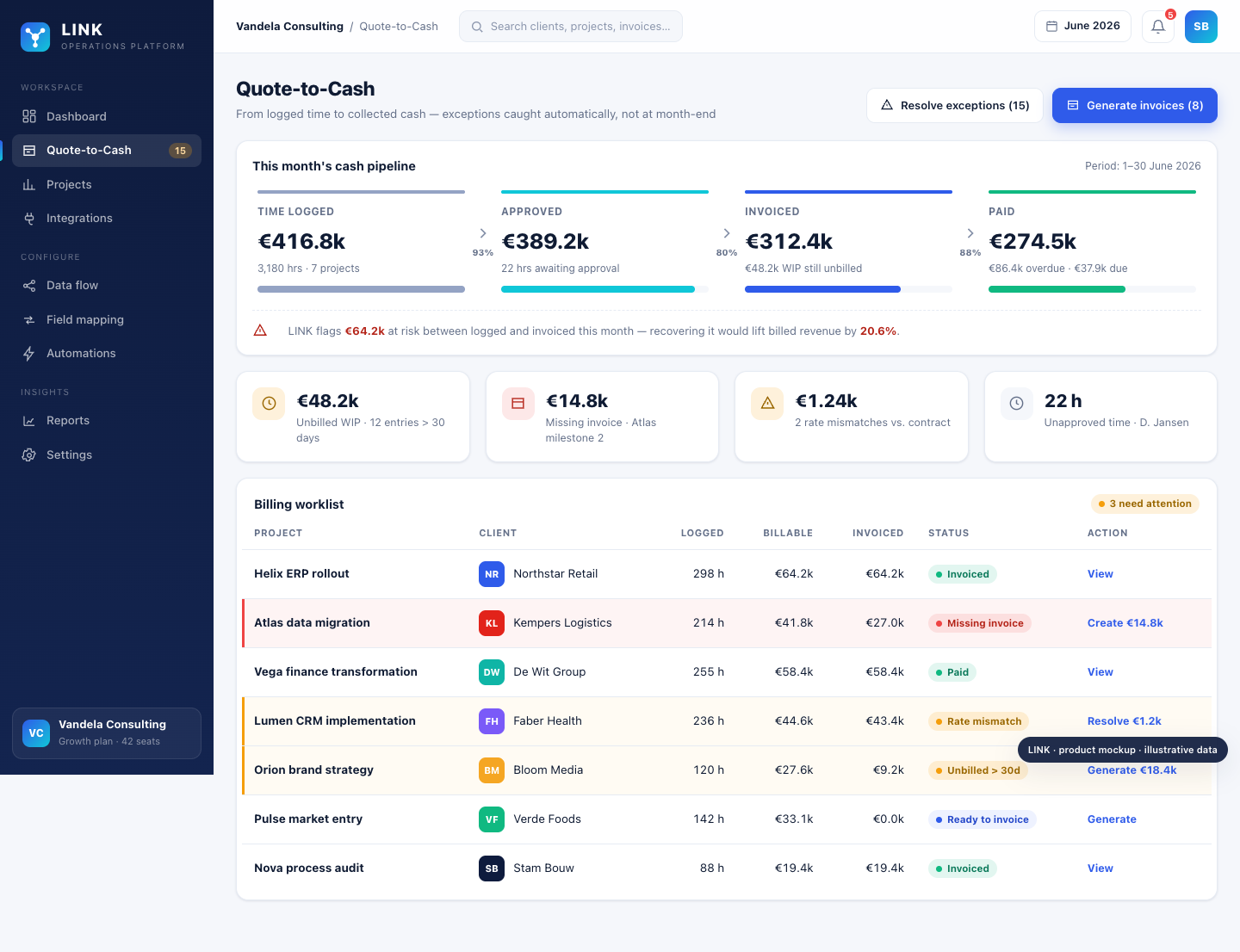
link.app / quote-to-cash
LINK quote-to-cash mockup
DashboardTests the single-source-of-truth promise: utilization, billed revenue, unbilled work, overdue invoices, and alerts.
Quote-to-cashShows the wedge workflow: logged time, approvals, invoice generation, exceptions, and at-risk revenue.
IntegrationsTurns supplier/API dependency into a visible operating control through connector health and sync activity.
ConfigurationConnection map, field mapping, and workflow builder show how service-led delivery becomes repeatable product logic.

Treat prototypes as capstone evidence.

  • Dashboard: Tests the single-source-of-truth promise around utilization, billed revenue, unbilled work and alerts.
  • Quote-to-cash: Shows logged time, approvals, invoice generation, exceptions and at-risk revenue.
  • Integrations: Makes connector health and API dependency visible.
  • Configuration: Connection map, field mapping and workflow builder show how service learning becomes repeatable product logic.
Operations plan

LINK starts hands-on because implementation quality is part of the product.

1

Discovery

Map current tools, pain points, billing flow, and success metrics.

2

Workflow design

Define source-of-truth rules, handoffs, exceptions, and automation scope.

3

Configuration

Set connectors, mappings, rules, dashboards, and alerts.

4

Validation

Test records, reconcile outputs, confirm invoice and finance logic.

5

Go-live

Train users, document responsibilities, and support the first cycle.

6

Optimization

Measure impact, monitor health, and identify reusable templates.

Defend hands-on delivery as part of early product value.

  • Discovery: Map tools, pain points, billing flow and success metrics.
  • Workflow design: Define source-of-truth rules, handoffs, exceptions and automation scope.
  • Configuration: Set connectors, mappings, dashboards, rules and alerts.
  • Validation: Test records and reconcile invoice and finance outputs before go-live.
  • Productization: Turn repeated implementation work into templates and playbooks.
Quality control and KPIs

The operations plan should be measured by both technical reliability and customer outcomes.

Because LINK sits near billing and finance workflows, uptime alone is not enough. The business must prove that integrations produce correct, trusted, and commercially useful operating data.

Technical

Connector health

Sync success rate, failed jobs, API latency, mapping errors, and incident frequency by connector.

Data

Reconciliation quality

Duplicate records, unresolved field conflicts, exception queue aging, and invoice-output accuracy.

Business

Workflow impact

Manual admin hours reduced, invoice-cycle time, billing exceptions resolved, and overdue visibility.

Scale

Productization

Service hours per customer, reusable templates, onboarding cycle length, and support load per account.

Make the operations plan measurable.

  • Technical quality: Connector health, sync success, latency, mapping errors and incidents.
  • Data quality: Duplicate records, unresolved conflicts, exception age and invoice-output accuracy.
  • Business impact: Reduced admin hours, faster invoice cycles, fewer billing exceptions and better overdue visibility.
  • Scale metric: Service hours per customer should fall as reusable templates grow.
Technology and compliance

The proposed reference architecture is modular, EU-oriented, and designed for financially consequential workflows.

Connector layerAPIs, webhooks, scheduled and event-driven sync
Orchestration engineMapping, transformation, rules, reconciliation
Unified data modelClients, projects, time, invoices, payments, contractors
Workflow layerDashboards, KPIs, alerts, automations, future agents
Presentation layerWeb dashboard, exports, notifications, invoice outputs

Data quality

Source-of-truth decisions, field mapping, reconciliation, and exception handling are core operating controls.

Compliance readiness

Invoice data, retention, VAT fields, Peppol/EN 16931 readiness, and GDPR practices shape the design.

Supplier risk

A production platform will depend on upstream APIs, so connector monitoring and modular architecture are essential.

Quality control

Technical reliability and business outcomes must both be measured after go-live.

Sources: European Commission n.d.a, n.d.b, n.d.d; Business.gov.nl n.d.b, n.d.c.

Tie architecture directly to business risk and compliance.

  • Modularity: Connectors, orchestration, unified data, workflow layer and presentation layer each reduce a specific operating risk.
  • Data controls: Source-of-truth decisions, field mapping and reconciliation are core controls, not optional features.
  • Compliance posture: Invoice fields, retention, VAT, Peppol/EN 16931 readiness and GDPR practices shape the design.
  • Supplier risk: Upstream APIs, authentication rules and data quality require monitoring and modular fallback.
Business model and roadmap

The model deliberately moves from concierge-led validation to product-led scale.

Year 1

Validate

MVP dashboard, selected connectors, quote-to-cash workflow, and first customer cohort.

Year 2

Repeat

Expand integrations, improve reporting, and standardize onboarding playbooks.

Year 3

Productize

Reusable templates, self-service setup, formal tiers, structured invoice readiness, and first automations.

Year 4

Expand

Deeper automation, packaged industry workflows, added capacity, and stronger governance.

Year 5

Scale

Predominantly software-led operations across broader sectors and regions, with agent assistance.

Connect the roadmap to the business model.

  • Year 1: Validate MVP dashboard, selected connectors, quote-to-cash workflow and first customer cohort.
  • Year 2: Repeat through broader integrations, better reporting and standardized onboarding.
  • Year 3: Productize through reusable templates, self-service setup, formal tiers, structured invoice readiness and first automations.
  • Years 4-5: Deepen automation, package industry workflows and scale a predominantly software-led operating layer.
  • Assumption: Service-led learning must become reusable product logic.
Lean model canvas

LINK's business model starts with one measurable workflow wedge.

Problem

  • Disconnected CRM, project, time, invoice and finance tools.
  • Manual reconciliation creates billing delay, leakage and weak cash visibility.
  • PSA and ERP replacement feels too heavy for 20-50 employee firms.

Solution

  • API-first operating layer across the existing stack.
  • Canonical model for projects, time, invoices and payments.
  • Dashboards, exceptions, source-of-truth mapping and workflow rules.

Unique Value Proposition

Connect, do not replace.

LINK turns the tools a consulting firm already uses into a finance-aware quote-to-cash operating layer.

  • One source of truth across work, billing and cash.
  • Faster path from logged time to collected revenue.
  • Operational control without a disruptive PSA or ERP migration.
Digital Baseplate for growing firms

Unfair Advantage

  • Narrow Dutch professional-services beachhead.
  • Finance-aware workflow ownership, not generic connectivity.
  • Hybrid delivery builds proof, templates and implementation know-how.

Customer Segments

  • Dutch consulting and professional-services SMBs.
  • Initial focus: 20-50 employee firms with quote-to-cash pain.
  • Buyers: owners, operations leads, finance/admin leads and delivery leaders.

Key Metrics

  • Days to first invoice reconciled.
  • Manual reconciliation hours saved.
  • Billing-cycle time, overdue exposure and exceptions resolved.
  • Connector uptime and onboarding effort per customer.

Channels

  • Founder-led direct B2B sales.
  • Design-partner pilots, reference customers and case studies.
  • Accountants, finance advisors, implementation partners and software vendors.

Cost Structure

  • Engineering, connector maintenance, cloud infrastructure and product operations.
  • Customer onboarding, success, support, implementation contractors and advisors.
  • Legal, accounting, data protection, security, sales and marketing.

Revenue Streams

  • Year 1 Pilot Essential: ~EUR 100/month plus onboarding.
  • Formal tiers launch in Year 3 at EUR 250/625/925 per month.
  • Onboarding ACV: EUR 5,000 in Years 1-2 and 5; EUR 8,000 in Years 3-4.

Use this slide to compress the business model into the nine Lean Canvas blocks.

  • Problem: Fragmented tools create reconciliation work, billing delay and weak cash visibility.
  • Customer: The beachhead is Dutch professional-services SMBs with 20-50 employees.
  • Value proposition: LINK connects existing tools into a finance-aware quote-to-cash layer without forcing replacement.
  • Business model: Subscription revenue plus onboarding/implementation, moving from concierge validation to repeatable product delivery.
  • Validation risk: The key test is whether pilots convert into recurring subscriptions and reusable onboarding patterns.
Financial plan depth

The financial plan is concrete, but the ramp assumptions still need validation.

The current five-year base case defines the projected customer path, pricing, implementation revenue, profitability and cash runway. The capstone should defend the assumptions, not present the forecast as certainty.

Base-case model snapshot

New customers6 / 12 / 45 / 140 / 250 from Year 1 to Year 5.
Active customers6 / 17 / 60 / 193 / 420 after churn roll-forward.
PricingYear 1 pilot ~EUR 100/month; formal EUR 250/625/925 tiers launch in Year 3; Y5 blended ACV EUR 7,500.
FundingEUR 600,000 pre-seed: ~EUR 300,000 validation and ~EUR 300,000 ramp-up; minimum cash ~EUR 258,000.
Year 5 revenueAbout EUR 3.51M total revenue, including subscription and implementation revenue.
Year 5 profitAbout EUR 1.41M net profit; after planned Years 2-3 investment losses, profitability returns from Year 4 onward.
Cash runwayBase case stays cash-positive; downside case dips negative in Year 3 before recovering.
Validation focusYear 4-5 acquisition, falling service hours, and EUR 1,000 additional implementation revenue need evidence.
Source: LINK five-year base-case financial projections, 2026.

Defend the model as a tested structure with assumptions still to validate.

  • Customer path: New customers are 6, 12, 45, 140 and 250; active customers reach 420 by Year 5.
  • Financial output: Year 5 revenue is about EUR 3.51M and net profit about EUR 1.41M.
  • Cash: Base case remains cash-positive with minimum cash around EUR 258K; downside needs a Year 3 bridge plan.
  • Risk test: Validate Year 4-5 acquisition capacity, service-hour reduction and expansion revenue.
Critical evaluation

The plan is promising, but several assumptions still need validation.

Demand risk

Customers may recognize the pain but delay action because manual workarounds feel adequate.

Willingness to pay

The team still needs proof of acceptable pricing and budget ownership in the ICP.

Implementation risk

Service hours could stay too high if workflows are less repeatable than expected.

Platform dependency

API changes, authentication rules, and upstream data quality can affect reliability.

Research limitation

Primary research is directional and should not be treated as statistically representative demand proof.

Mitigation

Use design partners to validate pain intensity, willingness to pay, onboarding effort, and measurable customer outcomes.

Use risk as evidence of judgment.

  • Demand risk: Customers may recognize the pain but delay action because manual work feels adequate.
  • Pricing risk: Budget ownership and willingness to pay still need proof.
  • Implementation risk: Workflows may be less repeatable than expected.
  • Platform risk: APIs, authentication and upstream data quality can affect reliability.
  • Mitigation: Design-partner pilots should validate pain intensity, value, onboarding effort and renewal intent.
Next research step

The next phase should validate the wedge before scaling the story.

1. Expand ICP discovery

Build beyond the three founder interviews with structured interviews and surveys among Dutch firms with 20-50 employees.

2. Run tailored demos

Follow up with interested interviewees and recruit in-ICP design partners to test comprehension, value, objections, and trust.

3. Pilot economics

Measure setup effort, time saved, invoice-cycle improvement, support load, and renewal intent.

The capstone conclusion is not that every assumption is proven. It is that the team has identified a focused, evidence-backed wedge and a disciplined path for validation.

Close the validation section with restraint.

  • Discovery: Expand beyond the three founder interviews with structured research among 20-50-employee Dutch professional-services firms.
  • Tailored demos: Follow up with interested interviewees and recruit in-ICP design partners to test comprehension, value, objections and trust.
  • Pilot economics: Measure setup effort, time saved, invoice-cycle improvement, support load and renewal intent.
  • Conclusion: The next step is validate, measure and productize what repeats, not scale immediately.
Team contribution

The work combined strategy, customer understanding, market access, and technical design.

Sachin Bijadi

Concept & strategy. Original product direction, strategic framing, and outcome focus.

Simeon Labuschagne

Customer success. Customer-centric delivery, adoption thinking, and service design perspective.

Wouter Stegenga

Market & operations. Dutch SMB proximity, operations experience, and market credibility.

Thiago M. Pinto

Platform architecture. Data platforms, integration infrastructure, and technical feasibility.

Make team contribution more than biographical.

  • Sachin: Strategic framing, original product direction and outcome focus.
  • Simeon: Customer success, adoption thinking and service design perspective.
  • Wouter: Dutch SMB proximity, operations experience and market credibility.
  • Thiago: Data platforms, integration infrastructure and technical feasibility.
  • Gaps: Legal, finance, security, engineering bench and repeatable GTM still need reinforcement.
Conclusion

LINK is a coherent capstone because the research, product, market, and operations plan reinforce one another.

The business plan starts with a real operating problem, narrows to a defensible market wedge, designs a product around the workflow, and defines a staged path from service-led validation to scalable platform delivery.

Research answer

Fragmented workflows remain a meaningful issue even in digitally mature SMB markets.

Strategic answer

The strongest initial wedge is Dutch professional services around quote-to-cash.

Execution answer

The next milestone is a design-partner pilot that tests demand, value, and repeatability.

Tie the capstone together.

  • Research answer: Fragmented workflows remain meaningful even in digitally mature SMB markets.
  • Strategic answer: Dutch professional services around quote-to-cash is the strongest initial wedge.
  • Execution answer: The next milestone is a design-partner pilot that tests demand, value and repeatability.
  • Final tone: The strength is evidence-backed focus, honest limitations and a clear validation path.
1 / 27 00:00